How do I start a cassava flour production line?
Cassava flour production line adopts mature technology, advanced equipment, scientific and rational process. The Cassava flour production line flow chart is washing, peeling, crushing, dewatering, drying, and packing, the whole line just need about 5 person to operate, final product could meet edible grade using for bakery and brewery.
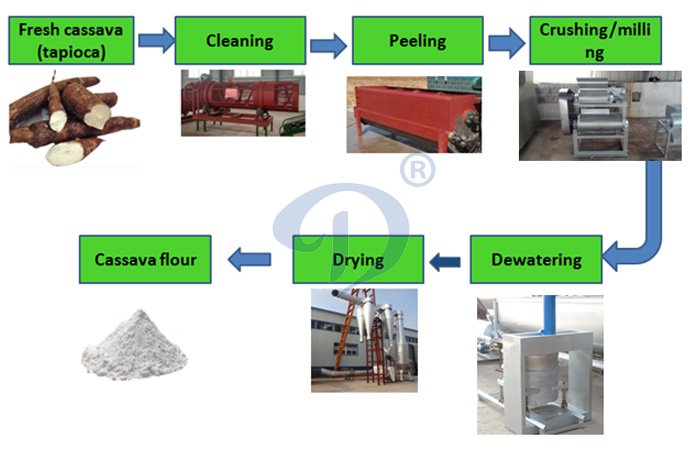
Cassava flour production line and the main cassava flou making machine
Cassava flour production line introduction:
1. Harvest matured cassava from the farm and load it to the high quality cassava flour (HQCF) production shed immediately. If the quantity of cassava harvested can not be carried in the same day for logistic reasons do not detach the cassava from the stem and leaf until the vehicle to carry it is ready. That is to say, fermentation will not occur if the cassava is still attached to the leaf and stem even if it has been uprooted. But care must be taken not to bruise the cassava when uprooting it.
2. Peel and wash the roots: Remove the stalk and woody tips from the roots. Peel the root with a hand-held peeler just like you would potatoes or carrots, then rinse them well. Peeling the root is also recommended since the peels naturally contain a very small amount of cyanide. However, it’s not a high enough amount to usually cause a problem and is nearly always thoroughly removed during manufacturing and heating.
3. Grate the roots: Grate cassava roots into a fine mash, using a hand-held grater or food processor.
4. Press and dry the roots: Pack the grated cassava mash into a clean bag or cheesecloth sack to press its water out. Get the cassava mash as dry as possible, then spread it onto a drying rack. Ideally, you can place the rack in the sun outside, or you can slowly dry the flour in a dehydrator or your oven at a low temperature. If you find that drying outdoors in the sun makes the cassava starch ferment and take on a sour, musty smell and taste, then use your oven instead. If you don’t have access to sunshine (it’s raining or you live in an apartment), this is a good time to dry cassava indoors too.
5. Mill and sift your flour: The dried cassava mash is ready when it produces a crumbly, white-colored flour. Gently mill/mash the flour into a fine texture with a mortar and sift through it to remove any clumps or leftover fibrous materials. Once it’s ready, you can use cassava flour in recipes right away or store it somewhere cool and dry for several months. Ideally use it within about three months to up to six months.
Leave a message about How do I start a cassava flour production line?